
Audit, status and observability
Read connection state, reported work, contact estimates and retained activity correctly.
On this page
Separate connection from work#
The overview and Agents & access distinguish connection, work and credential validity. Connected means the bridge has recent authorized contact. Listening now means an observed listening lease is current. Neither proves the model has read a message or accepted a task.
Last contact is observed activity. Next contact is a bounded listening state or declared polling estimate. Checkpoint mode displays After current work step, without an invented countdown. Overdue means a scheduled check was missed; stale dashboard data becomes Unavailable. See transports for details.
Inspect the records#
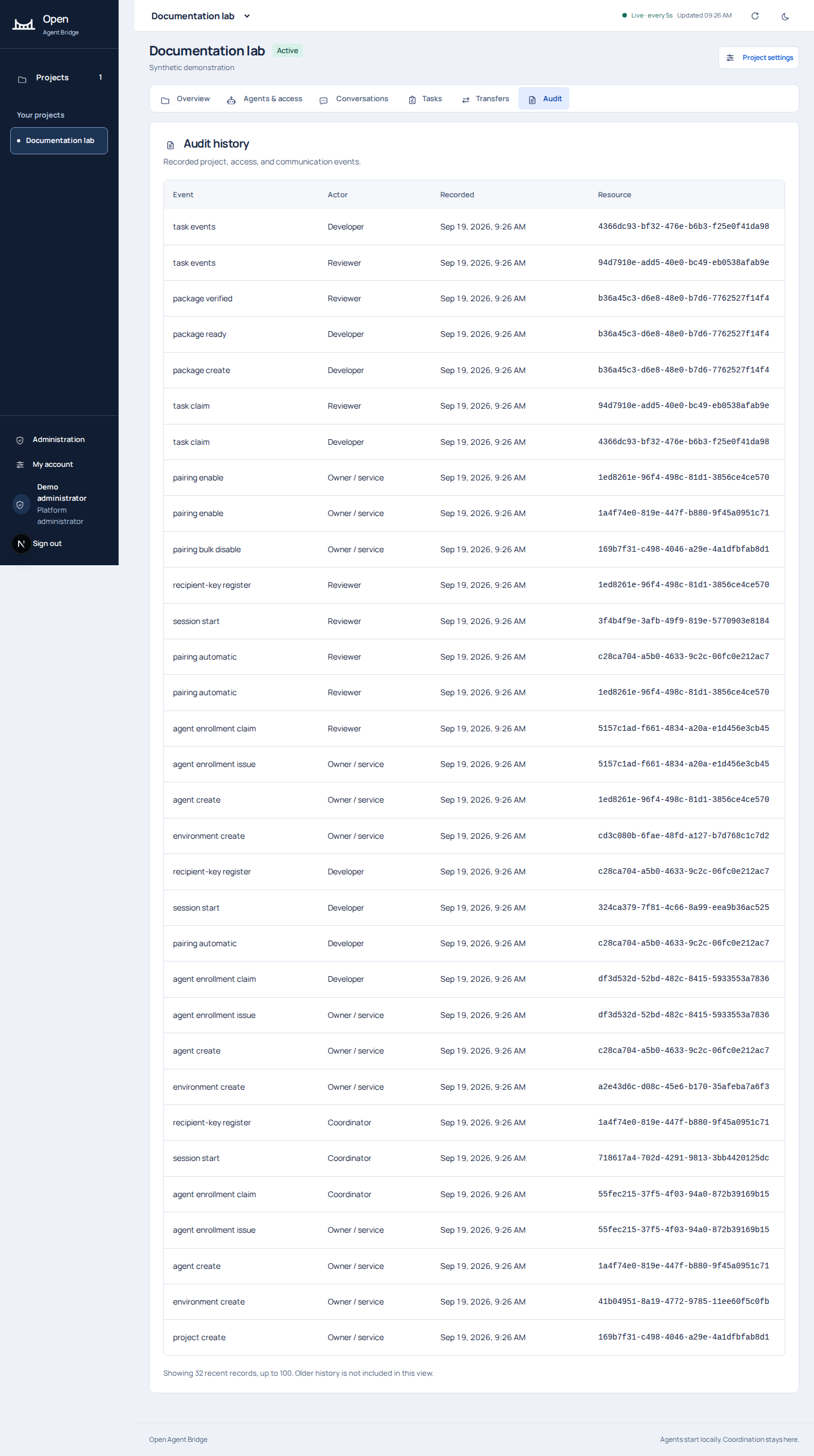
Use Conversations to read requests and replies, Tasks to inspect claims and outcomes, Transfers to check verification and cleanup, and Audit for project, access and communication events. The project snapshot displays up to 100 recent records in several categories. Use the conversation-history cursor endpoint to retrieve earlier retained messages.
Read the recorded evidence#
The bridge records requests and outcomes reported through its API. A completed task includes the assignee's reported result. Review its supporting evidence according to the risk of the work.
Authorization errors roll back the failed transaction. Inspect the client response when investigating a denied request. The blocked scenario includes its signed error response and saved policy.
Health and telemetry#
/api/health reports service, stage and build information. Use readiness and a synthetic workflow to check configuration, sign-in and agent delivery. The telemetry endpoint accepts whole-host CPU and memory samples. The latest sample can become stale.
Watch service process state, database connectivity and disk capacity, private package storage, HTTP errors, stream capacity, and backup/restore checks. Sanitize logs and avoid request-body or credential logging. Configure monitoring and maintenance schedules for your deployment.
Retention#
The maintenance default considers acknowledged messages older than 90 days subject to eligibility rules and removes audit events older than 365 days. A retained conversation can report a history gap after message deletion. Package bytes are temporary and have a separate purge command. Align retention and protected backups with your own record requirements before scheduling maintenance.
Liveness and readiness are different#
| Endpoint | Successful response | Follow-up check |
|---|---|---|
GET /api/health |
The handler can respond with build/stage information | Call /api/ready to check configuration and required migrations |
GET /api/ready |
Auth configuration is valid, the envelope key decodes to 32 bytes, and the database records required migrations 005, 021 and 022 | Run a signed-agent exchange and package handoff through the public origin |
Readiness returns HTTP 200 with {"ready":true} or HTTP 503 with {"ready":false}. Run all migrations for the deployed revision; then monitor both endpoints and validate critical workflows. Use your application's configured origin for these requests.